



ROAD TO STEPHEN GRAHAM JONES’ OFF THE RESERVATION: An Obsessive’s Fiction Review Column
Short stories are a form of magic. Perhaps dark magic, if we’re talking about horror short fiction here, though of course with SGJ we’re never talking about just one genre. For me, horror short fiction has always been that siren song, luring me out into the deep. It started with “The Tell-Tale Heart,” was re-ignited by Joyce Carol Oates’ 1966 story “Where Are You Going, Where Have You Been?,” and became truly ravenous when young Spencer discovered the cosmic tales of H.P. Lovecraft and the stacks of books collecting the short fiction of Stephen King.

For Stephen Graham Jones, you could say his siren song was, of all things, the author bio of late modern writer Stephen Dixon. As the legend goes, some 30 years ago, near the beginning of his career, SGJ would seek out that author bio at the end of a Stephen Dixon short story to stare at one particular magic number: “[Dixon] has some 300 stories published.” Jones would dream of having that many of his own stories out there. And though I may not have an exact count for you, I would bet that all these years later, he does. And then some. And, SGJ being the dictionary entry for “prolific,” he did it in half the time.
We’ve covered three novels and a novella in The SGJ Starter Pack; we’ve covered his trilogy of novels in Slasher 101 with Professor Jones… but today’s column, finally, is my recommendation of four SGJ books that collect about 120 short stories, all recently re-issued by Open Road Media in paperback editions.
The Short Fiction of Stephen Graham Jones
THE ONES WHO GOT AWAY: STORIES
Originally published as The Ones That Got Away 2010 by Prime Books
Re-issued 2025 by Open Road Media
Introduction by Laird Barron
This is, without question, one of my favorite short story collections I have ever read, up there with 20th Century Ghosts (Joe Hill, 2005), Growing Things and Other Stories (Paul Tremblay, 2019), and Unfortunate Elements of My Anatomy (Hailey Piper, 2021). Days after finishing it, I still felt as if I were walking through a dream, and it was those stories that were real life. As humans, our brains seek out patterns to be able to make sense of our reality, but these stories reject that—or, worse, they recognize it as an entry point into our deepest fears and insecurities and hopes. So many facets of our real lives cannot and never will be easily explained, and so we turn to stories and entertainment for the illusion of control and understanding, knowing (hoping) that by “The End,” it will all make sense. Jones’ characters learn a different truth, however—that life rarely comes in a neat little package, but rather it comes at you as a pack of wolves, as phantoms and ghosts, as a puzzle missing crucial pieces.
From what I’ve seen, the most talked-about story here is its opener, “Father, Son, Holy Rabbit”; but where the magic of this collection really seeps into your frontal lobe is a run of three stories in the second half: “Teeth,” “Raphael,” and “The Meat Tree.”
The first of the three follows a detective on the chase who maybe gets a little too much inside the serial killer’s mind. Jones states that he wrote “Teeth” to see if he had what it takes to write a full Se7en-esque novel. (The answer: a resounding “yes”… but more on that in our next column). The third (after a clever take on “The Hook”), “The Meat Tree,” took the detective angle away but kept the disturbing, spine-chilling “What the f*ck did I just read?”
The middle story, to me, is perhaps the most important story Jones has written. “Raphael,” on first read, may “just” be a beautiful, haunting tale about three friends who accidentally unlock a frightening magic that changes their lives forever. But, friends, it is so much more than that. As I read through the slasher trilogy of our last column, I came to realize that the Melanie of “Raphael” haunted Jones for years… until he could finally fully explore her terrifying story in the background of My Heart Is a Chainsaw, Don’t Fear the Reaper, and The Angel of Indian Lake. But I fear I’ve said too much. Go find out for yourself.
ZOMBIE SHARKS WITH METAL TEETH: STORIES
Originally published 2013 by Lazy Fascist Press
Re-issued 2025 by Open Road Media
Introduction by Jeremy Robert Johnson 
Like his other Lazy Fascist books, Zombie Sharks with Metal Teeth is, in short, SGJ’s excuse to just go full balls-to-the-wall and get weird with it. The transgression, the new weird, the comedic, the splatterpunk, the absurd.
To be honest, I’m having trouble summing up the whole of this book’s parts, except to say something like “It’s batshit, you’ll love it.” I can’t imagine this book making sense with any other title than the one it got. There’s mad scientists, there’s space lobsters, there’s slashers (duh), there’s the titular zombie sharks, and, oddly enough, there’s the opening flash fiction story about a man and his dog which somehow stuck with me more than any of the actual “batshit” story ideas to be found in the rest of the book.
STATES OF GRACE: STORIES
Originally published 2014 by SpringGun Press
Expanded Edition re-issued 2025 by Open Road Media
 As weird as Zombie Sharks may sound, believe it or not, States of Grace might just be the strangest book I recommend in this entire column series. I say that, of course, as the highest form of flattery. It’s weird, it’s lyrical, it’s poignant, it’s absurdly hilarious, and a million other things besides. These little stories pack in so much that I chose to read them with my partner (and editor), because I felt I may need a brain that has an MA in English just to suss out these stories’ full meaning. Flash fiction is SGJ’s favorite mode of storytelling; indeed, across these nearly 70 stories, you truly get the sense that he’s just walking around in his day-to-day scratching out flash stories on any writable surface he can lay his hands on, like he can’t get the words out fast enough.
A few favorites that stood out to me: “Bulletproof,” a beautiful tale of a family’s cycle of violence finally coming to an end; “When I’m Alone I Count Myself,” which plays on one of SGJ’s biggest, most singular tools in his writing, what I’ll call “magical thinking”—we all do some form of this in real life, counting down to a stoplight turning green, not stepping on sidewalk cracks, etc., but I’ve rarely seen it employed in fiction to the level that Jones uses it; “Animals I’ve Known”—if you’ve listened to any of the SGJ episodes of The Kingcast, you know he’s got some wild stories about animals; and “The Family That Reads Together,” a poignant fairytale about a father’s relationship with his children, who just want his love and attention.
Finally, “Why I Write”: it may be “flash,” but it ain’t “fiction”; still, it’s beautiful, and anyone who has grown any kind of appreciation for Stephen Graham Jones, his stories, or the act of writing in general, will want to read this and read it and read it until you can recite your favorite lines. Mine? I’ll save that for my sign-off below.
AFTER THE PEOPLE LIGHTS HAVE GONE OFF: STORIES
Originally published 2014 by Dark House Press
Re-issued 2024 by Open Road Media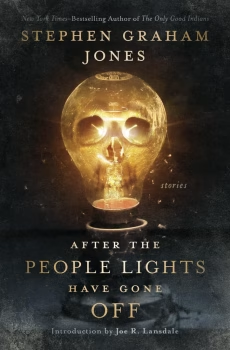 Introduction by Joe R. Lansdale
In my experience among SGJ fans, After the People Lights Have Gone Off stands as the favorite of all his collections. And while mine is The Ones Who Got Away, I do understand the sentiment. After the People Lights reaches similar heights and is perhaps more accessible. Plus, that title is just so damn cool.
One aspect of this collection that stands apart to me is how some of its stories exist in conversation with other authors’ short fiction that must have resonated with Jones. “Xebico” is a fun riff on the underrated 1926 classic “The Night Wire” (a story I first read as curated by Patton Oswalt for his Ghost Box series) and the mysterious identity of its author. And then there’s “The Spindly Man,” a brilliant dissection of King’s O. Henry Award winner, “The Man in the Black Suit.” I especially love these because they felt like a chance to sit in Jones’ classroom with his university students, a chance to see his academic side in full force.
One last note: Though we’re talking about the Open Road Media re-issues here, it’s worth tracking down the original out-of-print edition of After the People Lights, for its gorgeous interior illustrations.
For Extra Credit
Unfortunately, it seems the general reading population considers short story collections and anthologies to be a tall order. To me, they are where the real magic lies, but I understand that it’s easier to sell a novel with one continuous narrative. So if you hesitate for any reason in picking these up, I figured I could give you a chance to test the waters with a little extracurricular reading. SGJ has several ebook-only stories, and even more online-only ones if you want to go hunting for treasure. There’s “Attack of the 50 Foot Indian” (2020, Saga Press), and his Amazon Original Stories, but where I suggest you start is with his Tor.com Original stories. It’s since been re-named to Reactor Magazine, but all six of those stories—“Chapter Six” (2014); “The Night Cyclist” (2016); “Wait for Night” (2020); “Men, Women, and Chainsaws” (2022); “Parthenogenesis” (2024); “The Belle of the Ball” (2025)—are free to read on their website. My hope is that by the end of the first one, you’ll understand that these collections are simply not to be missed.
Until next time, here’s my promised sign-off:
“I don’t write because I want to live forever. I write because I want to live now.”
Spencer Hamilton
OUR ROAD MAP
All the Beautiful Sinners
The Long Trial of Nolan Dugatti
It Came from Del Rio
The Ones Who Got Away ***
Zombie Bake-Off
Three Miles Past: Stories
Zombie Sharks with Metal Teeth ***
The Least of My Scars
Sterling City
The Gospel of Z
States of Grace ***
After the People Lights Have Gone Off ***
Mongrels
Mapping the Interior
Night of the Mannequins *
The Only Good Indians
My Heart Is a Chainsaw **
Don’t Fear the Reaper **
The Angel of Indian Lake **
I Was a Teenage Slasher *
The Buffalo Hunter Hunter
Killer on the Road/The Babysitter Lives *
Off the Reservation, out October 13, 2026
OUR ROAD MAP KEY
* SGJ Starter Pack
** Slasher 101 with Professor Jones
*** Short Fiction of SGJ
ABOUT THE AUTHOR
SPENCER HAMILTON is a queer horror author living in Pennsylvania. His fiction includes the novel The Fear and novellas Welcome to Smileyland and Sister Funtime. His short fiction has been collected in Kitchen Sink and I Will Devour You and Other Promises, and has appeared in several anthologies, most recently Punk Goes Horror II from Truborn Press. He is the editor of the queer horror anthology There’s More of Us Than You Know. You can find him on Instagram as @spencer.hamilton.books.
